



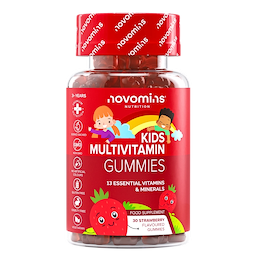

L-theanine is an amino acid found naturally in tea leaves, and it now appears in many children's gummies. If you are thinking about buying one, you probably want three answers first: is it safe for children, how much should a child have, and what has research found. This guide covers each one, based on the published studies we have read, and explains when to speak to your GP first.
The short answer is that research in children is limited. The children's studies we found were small, and all of them involved children or teenagers with a diagnosed condition, such as ADHD or a tic disorder. The largest, a six week trial in 98 boys aged 8 to 12, reported that L-theanine was well tolerated. No nutrient reference value (NRV) has been set for L-theanine, so follow the label of any product you choose.
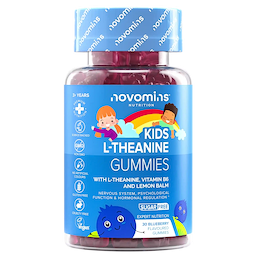
Our kids L-theanine gummies contain 50mg of L-theanine per gummy, with lemon balm extract and vitamin B6. Vitamin B6 contributes to normal psychological function.
What is L-theanine?
L-theanine is a naturally occurring amino acid found primarily in green tea leaves.

View as text
L-Theanine content
- Green Tea: Highest Concentration of L-Theanine
- Black Tea: Lower amounts than green tea
In tea, L-theanine comes with caffeine. A supplement uses L-theanine on its own, so our kids gummies contain no caffeine. For scale, a cup of black tea contains around 20mg of L-theanine (Nobre and colleagues, 2008).
Is L-theanine safe for children?
In the largest study we found that included children, L-theanine was well tolerated. Research in children is limited, though, so it helps to know what that study did and did not test.
The largest study we found gave 98 boys aged 8 to 12, all diagnosed with ADHD, 400mg of L-theanine a day for six weeks, as two chewable tablets twice a day. That is eight times the amount in one of our gummies. The researchers reported it was well tolerated, with no significant adverse events.
Two limits matter. The trial lasted six weeks, so it cannot tell us about taking L-theanine for months or years. And every child in it had a diagnosed condition, so the results may not apply to all children. Small, short studies are not designed to show long term safety.
Age matters too. The youngest children in the studies we found were 4 years old. Our gummies are labelled for children aged 3 and over. For a young child, speak to your GP, pharmacist or health visitor before giving any supplement.
Speak to your GP or pharmacist first if your child:
- takes any prescribed or over the counter medicine
- has a health condition, or is waiting for an assessment
- already takes another product that contains L-theanine
Some focus products sold to teenagers combine L-theanine with caffeine. They are not made for children, so check the label before you buy.
If your main worry is your child's sleep, mood, behaviour or attention, start with your GP. A supplement is not a substitute for that conversation.
How much L-theanine can a child have?
No nutrient reference value (NRV) has been set for L-theanine. Unlike vitamins and minerals, there is no daily reference amount to measure against, so the amount to give is the one on the label of a product made for your child's age.
For scale, here are the amounts found in tea and used in published studies.
| Source | Who | Amount of L-theanine |
|---|---|---|
| A cup of black tea | Not applicable | Around 20mg |
| One Novomins Kids L-Theanine Gummy | Children aged 3 and over | 50mg |
| Brain wave study (2008) | Healthy young adults | 50mg, one dose |
| Four week trial (2019) | 30 healthy adults | 200mg a day |
| Single dose study (2020) | 5 boys with ADHD | 2.5mg per kg of body weight, with and without caffeine |
| Six week trial (2011) | 98 boys aged 8 to 12 with ADHD | 400mg a day |
Give the amount on the label and no more. Do not give two products that both contain L-theanine unless your GP or pharmacist has said it is fine.
When should a child take L-theanine?
Follow the label of the product you choose. Our kids gummies are one a day, with or without food, and you can give the gummy in the morning before school or before an activity. Ask your child to chew it well before swallowing. Store the bottle out of reach of young children, because gummies look like sweets.
What does the research say?
Research on L-theanine in children is at an early stage. The studies are small, most are short, and they involve children with a diagnosed condition. They do not show that L-theanine treats or prevents any condition.
Studies in children
Sleep in boys with ADHD (2011). In the six week trial above, boys who took 400mg a day had higher sleep efficiency scores on wrist monitors than boys given a placebo. The time taken to fall asleep did not change, and parents' own sleep questionnaires did not match what the monitors recorded. The authors called for larger, longer studies.
Tics and anxiety (2022). An open label pilot study in 34 children aged 4 to 17 with Tourette syndrome or a chronic tic disorder, plus anxiety, compared a supplement of L-theanine and vitamin B6 with psychoeducation. Both groups improved. Everyone knew which option they were given and there was no placebo, and the authors said placebo controlled trials are needed.
Attention, with caffeine (2020 and 2026). Two small studies gave single doses of L-theanine, mainly combined with caffeine, to young people with ADHD: one with 5 boys, one with 21 young people aged 10 to 19. They tested one dose in a lab setting, so they tell us little about a daily gummy that contains no caffeine.
Studies in adults
Other studies have been in adults. A brain wave (EEG) study in healthy young adults recorded a greater rise in alpha activity after 50mg of L-theanine than after a placebo. A four week trial in 30 healthy adults taking 200mg a day reported lower scores on questionnaires about stress related symptoms and sleep. Two of that trial's authors worked for the company that supplied the L-theanine. Results in adults do not automatically apply to children.
What UK rules say about L-theanine claims
The Great Britain nutrition and health claims register records which health claims are authorised. Claims that L-theanine improves cognitive function, eases psychological stress or supports normal sleep were assessed in 2011 and are listed as not authorised, because the evidence assessed did not substantiate them. That is why we do not make health claims for L-theanine. The claims on our gummies come from vitamin B6.
Lemon balm
Our gummies also contain 5mg of lemon balm extract. A 2024 review of lemon balm research, funded by an ingredient supplier, concluded that further well designed randomised controlled trials are needed. The lemon balm food studies we read were in healthy young adults.
The bottom line
A food supplement is not a treatment for ADHD, anxiety, tics or sleep problems. If you are worried about any of these, speak to your GP. If you choose a supplement, pick one made for children, check the amount per serving and follow the label.
What to look for in an L-theanine supplement for children
When selecting an L-theanine supplement for your child, several factors are worth considering:
- Ingredient Transparency: Look for supplements that clearly list the amount of L-theanine per serving as well as other NRV values.
- Manufacturing Processes: Check that manufacturing facilities have the necessary certifications and that the products are tested for quality. (NSF Certification, 3rd Party Testing)
- Clean Formulation: Consider options without unnecessary additives like artificial colourants, artificial flavourings, or any genetically modified ingredients.
- Made for children: choose a product labelled for your child's age, with a clear amount per gummy and a daily limit.
- No caffeine: some focus products for teenagers add caffeine, so read the ingredient list.
- Claims that follow the rules: every L-theanine health claim on the Great Britain register is listed as not authorised, so be wary of labels that promise focus, calm or better sleep from L-theanine.

About Novomins Kids L-Theanine Gummies
Our Kids L-Theanine Gummies are blueberry flavoured gummies labelled for children aged 3 and over. Each gummy contains 50mg of L-theanine, 5mg of lemon balm extract and 1mg of vitamin B6, which is 71% of the NRV. Vitamin B6 contributes to normal psychological function and to the normal functioning of the nervous system.
They are low in sugar, vegan and halal, with no caffeine, artificial colours or preservatives. One gummy a day is one serving.
See also our kids gummy bundle, or browse all kids gummies.
Remember: Always consult with your healthcare provider before starting any new supplement, especially for children with existing health considerations or who take medications.